History of the Village of Hancock
About this information: The text shared here was originally posted on 1hancock.com and preserved in the Internet Archive Wayback Machine; view that website as it was in January, 2005. Additional images came from I Grew up In Hancock, Or WISH I Grew Up in Hancock, Facebook.
Photos and story by Jerry Carlton
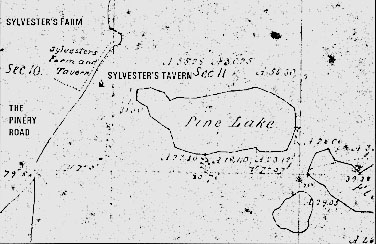
In 1850, two years after the admission of Wisconsin to the Union, William Sylvester Jr. son of the government’s Indian blacksmith, settled in section 10, Township 19 North, Range 8 East, at the present site of the Village of Hancock and opened a tavern for travelers along the pinery road from Portage to Stevens Point. Sylvester’s father, William Sr., owned the Marsh House, another stop-over on the trail into the northern pineries, at Grand Marsh in Adams County. The tavern and inn was located approximately at what is now 134 S. Main Street (near the western end of a lake). William Jr.’s inn was known as the Pine Lake House and offered accommodations and nourishment for the teamsters and oxen hauling supplies northward.
The spot Sylvester chose for his farm and tavern was located on the western edge of the end moraine created by the last glacier to cover northeastern Wisconsin. This moraine (consisting of sand, gravel and rubble) pushed ahead of the glacier as it moved westward. The moraine runs in a northeasterly direction from section 33 to section 2 in the Town of Hancock and is considered the watershed divide between the Wisconsin and Fox Rivers. To the east lies a string of lakes, beginning with Pine and Fish Lakes in the Village and Towns of Hancock and Deerfield; Marl Lake and the Mill Pond in the Town of Deerfield. To the west lies the flat, sandy soil of northern Adams County which was once the bed of glacial lake Wisconsin.
At the time of Sylvester’s arrival the area was largely unsettled except for a few squatters along the pinery road and Native Americans of the Menomonee Tribe. On October 13, 1848 at Lake Poygan, the Menomonee ceded by treaty to the Federal Government a considerable tract of land west of the Fox River that had long been known as “the Indian Land.” This area included nearly all of what is now Waushara County. Under the terms of the agreement the Native Americans were to remain in possession of the land for two years and thereafter until possession was demanded.
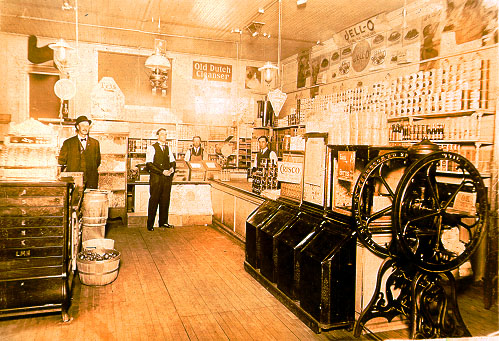 George M. Scott Store on the west side of the street. Photo taken on April 14, 1914. Pictured are G.M. Scott, J.C. Barton, Jas Halford and Tim Brown.
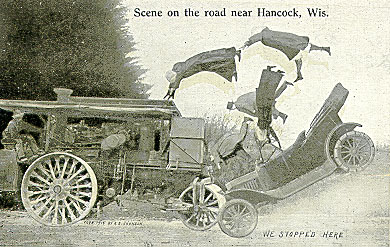 A humorous postcard depicting the hustle and bustle of automobile traffic. Postmarked 1920.
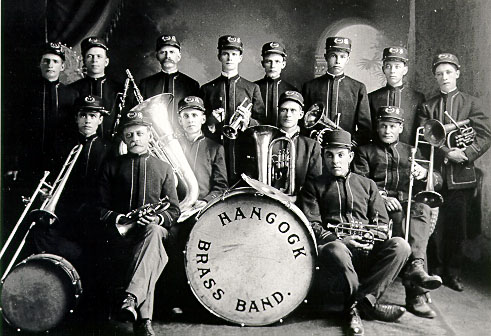 The Hancock Brass Band near the turn of the century.
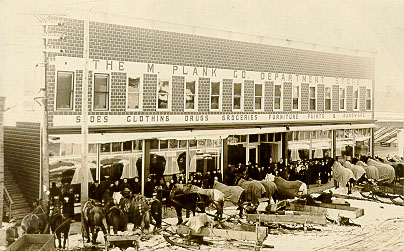 The M. Plank Department Store circa 1890.
On February 15, 1851 Governor Nelson Dewey approved the state legislature’s act to create Waushara County which was organized as one town. A few days later the county was divided into three townships with Township 19 being part of the Town of Wautoma. Between November 1st and November 8th Township 19 North was surveyed by Charles Phipps who was contracted by the Surveyor General of the United States. Phipps found the surface of the Township to be “gently rolling” and the “soil second rate.” Timber included black, burr and white oak as well as pine with undergrowth of oak bushes. Nearly all of the land along the pinery road between Pilot Knob (Adams County) and County Highway C (south of the present Village) was open country. A large portion between Coloma Corners and Hancock was known as the Burr Oak Prairie.
In the fall of 1852 the Native Americans were removed and the land was formally opened for settlement. Although pioneers like William Sylvester had been living on the land prior to formal government surveys, they had acquired no legal title and were thus required to file claims and purchase their property generally from the Government Land Office in Stevens Point.
In 1853 the Town of Coloma was created to include the present towns of Coloma and Hancock, but William Sylvester Jr. did not remain in the area long. In about 1853 he sold his 160 acre farm to Benjamin Chamberlain, who continued to operate the hotel which was one of three along the pinery road in what was then the Township of “Culloma.”
In 1854 Chamberlain owned the only taxable land in section 10 at the present location of the Village of Hancock; although other pioneers had acquired property along the pinery road known as the “Portage Road” to the southwest. Among them were Abner and William Stannard, William and John Turnoff, Hosea Hugoboom, Tibetts, Grow, Maxon, Wood, and Hiram Barnes who that same year was appointed overseer of roads for Town 19 North. Early land owners bordering the Pine and Fish Lakes included Hockenberry, Nelson, Crawford and Parker.
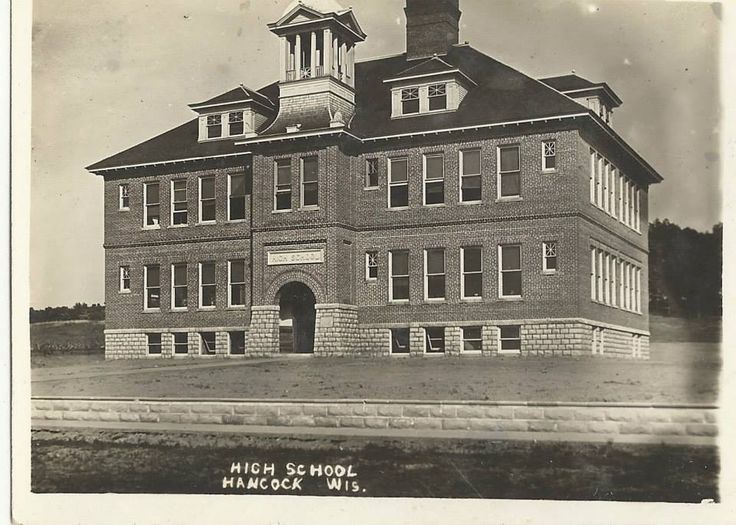 Hancock High School constructed in 1907-1908 in front of what is now the Hancock Area Community Center.
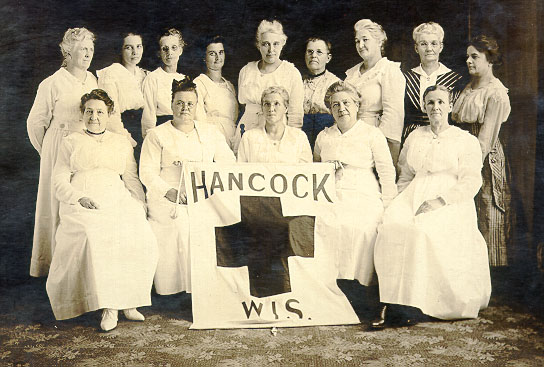 Hancock Red Cross workers during World War I.
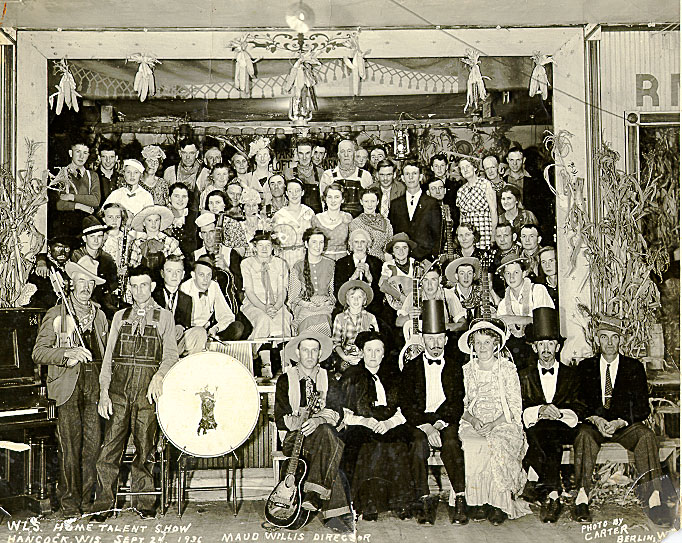 WLS Home Talent Show taken on September 24, 1936.
The first school district formed within Township 19 North in 1853 was three miles square and included the southern halves of sections 15, 16 and 17 south to a center line through sections 32, 33 and 34. Since most of the settlers of the township lived within this area the school house was located on the west side of the Portage Road in the southwest quarter of the northwest quarter of section 28. The building was a small, frame structure with a sloping roof. One teacher (perhaps the only one) was Lucy Miltimore of the Town of Plainfield. While teaching there she became acquainted with Brown Hugoboom whom she eventually married.
The present Town of Hancock was created from Coloma in 1855 and was known as “Sylvester;” no doubt in honor of its first settler. However, during the meeting of the Waushara County Board of Supervisors held in Wautoma on November 11, 1856 Sylvester Richmond, representing the Town of Sylvester, presented a petition to change the name of the township to “Hancock.” On November 14, 1856 the order was introduced and duly passed. Richmond may have objected to having the same name as the township in which he lived or the name “Hancock” may have had another significant meaning. The reasoning for the change remains unknown.
By 1856 nearly all of section 10 surrounding the Chamberlain Hotel had been purchased from the Government or non-resident land speculators. Daniel Ostrum owned the north half of the southwest quarter; Jerome Rawson owned the east half of the northwest quarter and the northwest quarter of the northeast quarter; and others including John Lake, Thomas M. Fowler, H.I. Snider and Doty Tubbs had other acreage. E. Graves and Lewis Holcomb owned one-acre lots and houses and F.B. Munson of Wautoma owned a store operated by James F. Wiley. Settlement surrounding Pine Lake was also taking place with land purchases by Ordway and Hammond.
During the early years mail for Hancock, as well as the townships of Coloma, Deerfield and Richford, was received from the post office established on June 19, 1851 at Richford, then called “Adario.” As settlement along the Portage Road increased however, mail was delivered at the Chamberlain Hotel by a stagecoach that passed through on its way from Stevens Point to Portage.
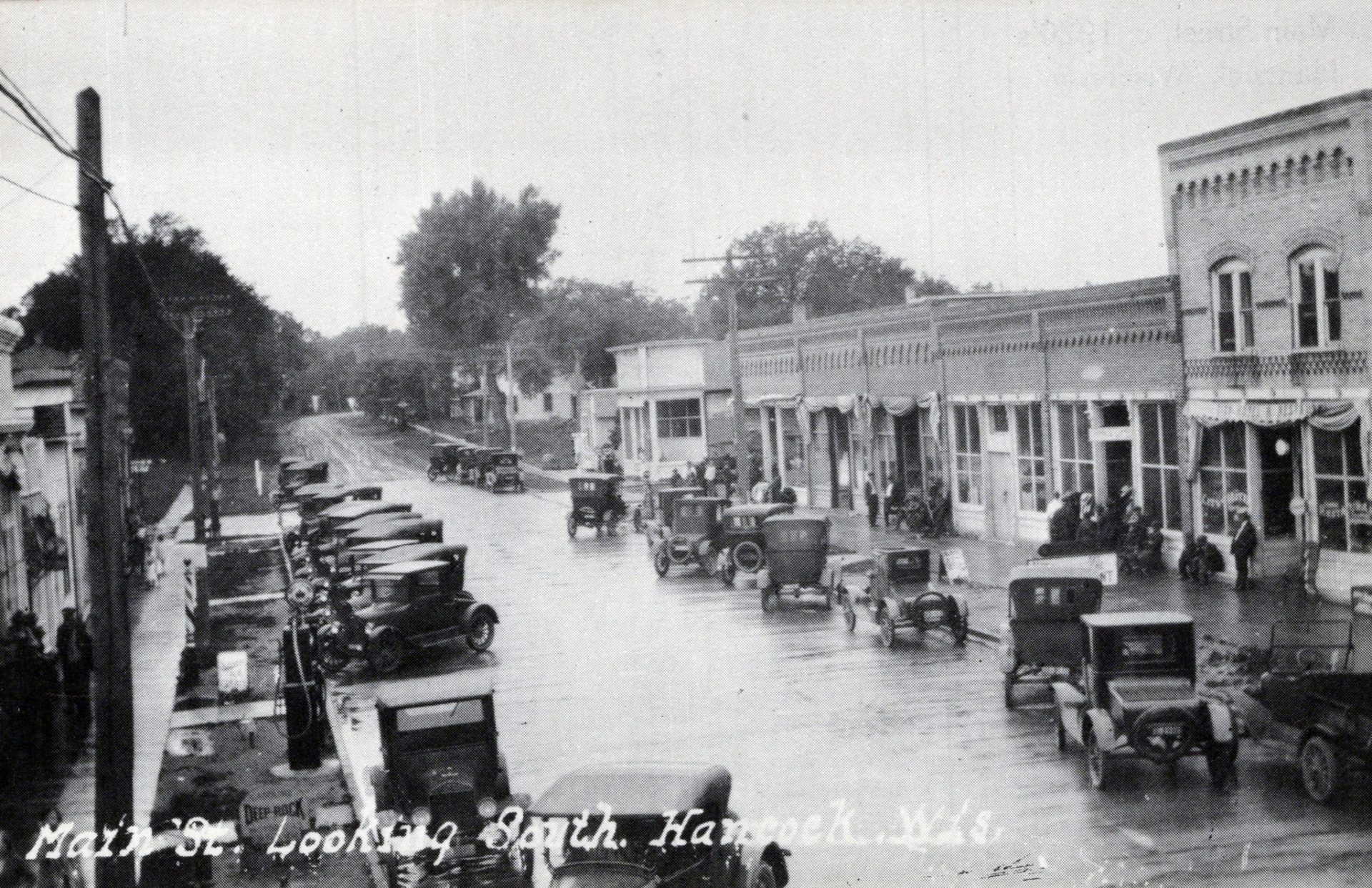 Main Street looking south. Hancock, WI circa 1925.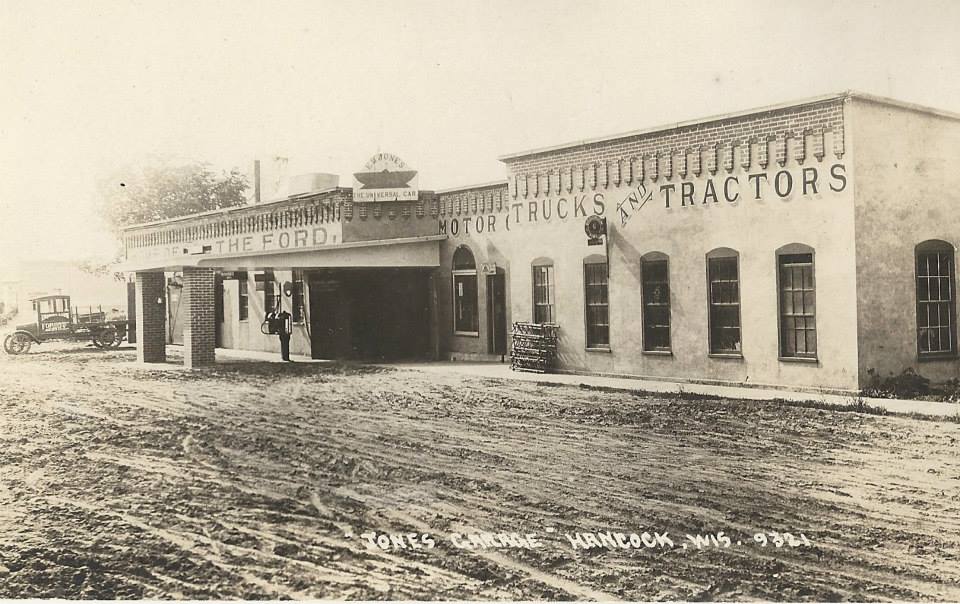
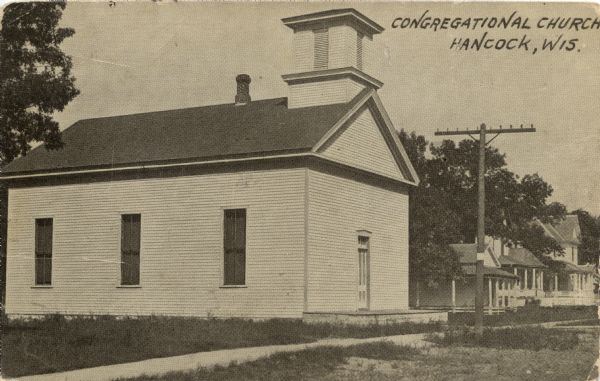 The church was rebuilt in the same location, almost identically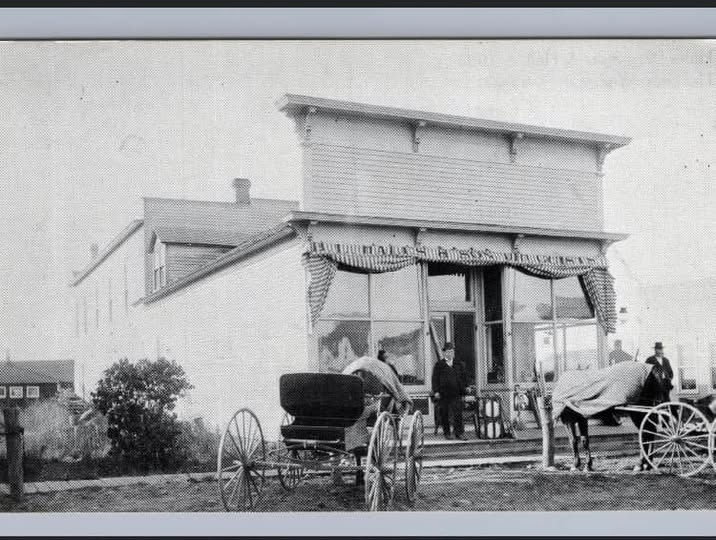
A tri-weekly stage line along the Portage Road had been established as early as 1852 by John B. Dubay whose carriages were equipped with “elliptic” springs and drawn by two horses. The fare from Portage to Stevens Point was $3.50 with return costing $3.00. In 1853 another line was established by Myers, Kollock and Wigginham of Buena Vista in Portage County. Regular stops included the Bur Oak Prairie House owned by John Drake in section 7 of Coloma Township, the Bronson Hotel at Coloma Corners and the Chamberlain Hotel in Hancock.
James F. Wiley eventually purchased the Munson Store and a small school was built on the south side of the lake; even so, development during the mid-nineteenth century was slow. It was not until the fall of 1875, when a line of the Wisconsin Central Railroad was constructed between Portage and Stevens Point, did the community begin to grow more rapidly.
The coming of the railroad may have been the most important event in the history of the village. Previously all freight and products were hauled in and out by teams to and from Berlin, Stevens Point, Grand Rapids and Wausau. Both shipping and transportation became easier for merchants as well as residents which resulted in the construction of more stores and homes.
In the 1870’s the Congregational Church was built on North Main Street and a three-story hotel was constructed on the corner of E. North Lake and Main. J.F. Wiley had been appointed postmaster with mail being delivered to his store and another school had been built for the children living in the northern part of the township.
During the 1890’s many residences were built along with a two-story school at the northeast corner of N. Main and School Streets, but the community’s first large fire on February 14, 1893 destroyed many buildings on Main Street. A second fire on April 3, 1894 however, was much worse. The main business district, consisting of many wood-frame buildings between North and South Lake Streets on both sides of Main Street, was largely destroyed.
Despite the loss to the community and its residents, the Village was soon rebuilt. Most of the new buildings were constructed of red brick obtained from Stevens Point. In September of 1894 The Hancock News began operation in what is now the Hancock Econowash. In 1895 the cornerstone of the Methodist Episcopal Church was built opposite 305 E. North Lake Street and a telephone system was established in 1898.
In 1902, having reached the required population, the Village of Hancock was incorporated. Better streets were constructed and cement sidewalks were paved. In 1906 the Hancock Volunteer Fire Department was organized and as a result of lively discussion at a school meeting in the summer of 1906 a new brick high school was erected during 1907-1908 in front of what is now the Hancock Area Community Center.
As with many small communities, progress in the early twentieth century began to slowly take its toll. With the advent of the automobile residents were afforded easier access to goods and services outside the somewhat self-sufficient village and they no longer had to rely on local merchants for all of their needs.
The blacksmith and harnessmaker shops became gas stations and garages. The butcher, milliner and tailor were replaced by packaged foods and store-bought clothes. The local theater gave way to the television set appearing in every home,and as years went by many merchants found they could no longer rely on local patronage to support themselves.
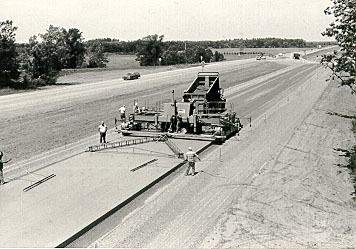
And yet, despite the removal of the railroad in 1946, the rerouting of Highway 51 years later and the resulting loss of school and businesses to the community, the Village of Hancock still retains its most valued assets: the lakes nature made long before William Sylvester first came.